
Find Your Zen: Get Out of “Fight or Flight” with chiropractic care

Chiropractic care helps you regulate your stress response
Modern life keeps many of us in a constant state of stress. Deadlines, screens, poor sleep, emotional pressure, chronic pain, and physical tension can leave the body stuck in “fight or flight” mode — a state driven by the sympathetic nervous system.
When this stress response stays switched on for too long, it can affect far more than mood. People may experience:
muscle tension and headaches
fatigue and poor sleep
digestive issues
increased pain sensitivity
anxiety or feeling “wired but tired”
difficulty concentrating
reduced resilience to everyday stress

Being stuck in flight or flight has a negative impact on health
Your autonomic nervous system has two major branches:
Sympathetic nervous system — the “fight or flight” response
Parasympathetic nervous system — the “rest, recover, and regulate” response
In a healthy body, these systems constantly adapt and balance each other. Stress, pain, injury, poor posture, and lack of movement can all contribute to an overactive sympathetic state.
One of the ways researchers study this balance is through heart rate variability (HRV) — a measure of how adaptable the nervous system is. Higher HRV is generally associated with better resilience, recovery, and parasympathetic activity.
What Does Chiropractic Have to Do With the Nervous System?
The spine is not simply a stack of bones — it is a highly sensory structure filled with receptors constantly communicating with the brain.
Research suggests spinal dysfunction and altered movement patterns may influence how the brain interprets and responds to sensory information. Chiropractic adjustments aim to restore healthy movement and input into the nervous system.
Several studies have investigated whether spinal manipulation can influence autonomic nervous system activity, including changes in heart rate variability, skin conductance, and other physiological markers associated with stress regulation.
The evidence suggests chiropractic care may help stimulate parasympathetic activity — the branch associated with recovery and relaxation — particularly in the cervical spine.
Other research has demonstrated measurable changes in autonomic nervous system markers immediately following spinal manipulation or mobilization.
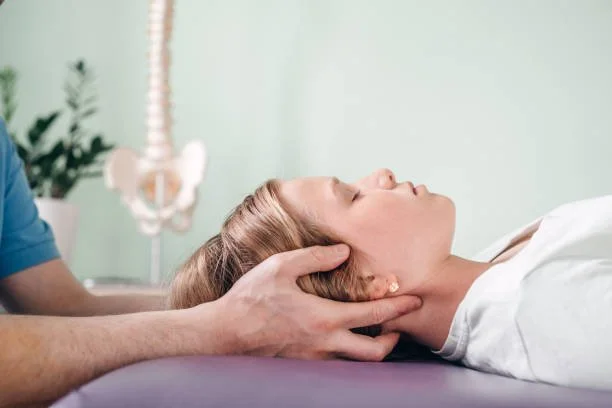
Research suggests neck adjustments may improve your ability to recover and relax
Clinically, many patients report that after an adjustment they feel:
lighter
calmer
able to breathe more deeply
less tense
mentally clearer
more relaxed
While these experiences are subjective, they align with the growing understanding that the body and brain are deeply interconnected.
Stress Is Physical Too
We often think of stress as purely emotional, but stress is also physical.
Long hours sitting, poor posture, muscle guarding, jaw tension, shallow breathing, and persistent pain all feed information back into the nervous system. Over time, this can reinforce a chronic stress state.
Chiropractic care aims to help restore healthy movement, reduce mechanical stress on the body, and improve how the nervous system processes sensory input.
Combined with sleep, exercise, nutrition, breathing practices, and healthy lifestyle habits, chiropractic can form part of a broader strategy to help the body shift from survival mode toward recovery and resilience.
Finding Your Zen
True health is not just the absence of pain — it is adaptability.
A well-regulated nervous system helps us recover faster, sleep more deeply, think more clearly, and respond to life’s challenges with greater resilience.
While chiropractic care is not a magic solution to stress, emerging research suggests it may play a valuable role in supporting nervous system function and helping the body move out of chronic “fight or flight” patterns.
Sometimes the first step toward feeling calmer is helping the body remember that it is safe to relax again.

A well-regulated nervous system lets you relax
References
Picchiottino M, et al. Chiropractic & Manual Therapies (2019) — Systematic review on joint manipulation and autonomic nervous system activity.
Sampath KK, et al. Journal of Manual & Manipulative Therapy (2024) — Systematic review and meta-analysis on spinal manipulation and autonomic nervous system effects.
Younes M, et al. Chiropractic & Manual Therapies (2017) — Study examining spinal manipulation and cardiovascular autonomic control in low back pain patients.
Henley CE, et al. Osteopathic Medicine and Primary Care (2008) — HRV changes following manual therapy intervention.